The Family Law Amendment Act 2024 details changes to the Family Law Act 1975, with the Amendment having rolled out in June 2025. This means that since June 2025, there have been significant changes to the Family Law Act that will likely affect your own case management and Court proceedings relating to property or financial settlements, spousal maintenance, and other Family Law matters.Below, our legal team at Oxford Partners Lawyers have summarised the Family Law reforms that were rolled out as of June 2025 for your ease of reading.
Summary of Major Family Law changes (June 2025)
Schedule 1: Property
Family violence definition
The Amendment Act will now recognise economic or financial abuse as family violence within Section 4AB of the Family Law Act. This effectively means that the Court now considers controlling behaviours like restricting access to money, hiding assets, or taking out loans in a partner’s name as actions that purposefully create financial dependency and reduced autonomy for the affected partner.The Amendment will also include new examples of dowry abuse to support legal precedents for future cases that explore economic or financial abuse in culturally diverse families.
Property framework amendments
The Family Law Amendment Act also includes a simplified and codified 4-step process for dividing assets following a divorce or separation. The new framework is as follows:
Step 1: Identify the property pool
Outline all assets (income, property, savings, etc.), liabilities (businesses, debts, etc.), and superannuation interests.
Step 2: Assess contributions
Assess both financial (income, etc.) and non-financial (homemaking, parenting, etc.) contributions to accurately identify each party’s legal and equitable rights and interests in the total property pool.
Step 3: Consider future needs
Consider the current and projected future circumstances (i.e. age, health, income capacity, care of children, lasting impacts of family violence or economic abuse, etc.). At this step, the Court can use realistic projections of future needs to make an adjustment in favour of one party if it would be just and equitable to do so.
Step 4: Ensure the final outcome is just and equitable
Determine the final overall percentage split of the property pool. Here, the Court must outline specific properties, finances, and liabilities to implement the proposed split, and be satisfied that the proposed split is fair and equitable.Note that Family Law Courts can approach these steps in any order. The framework is not considered to be a linear process, but rather to provide a clear pathway for amicable separations that balance both contribution and circumstance.
Spousal maintenance
Under the Amendment Act, family violence has now been added into the list of factors that the Court can consider when assessing grounds for spousal maintenance orders. Where relevant, the Court will now consider the economic effects of incidents of family violence to which one party has subjected or exposed the other party.
Companion animals
Under the Amendment, pets that aren’t assistance animals nor kept for more than one purpose (i.e. companionship and sheepherding, for example), will no longer be treated as property but rather as ‘companion animals’. In determining which party will be granted rights of ownership to a companion animal in separation or divorce proceedings, the Court can now take into consideration:
Any history of actual or threatened abuse towards a companion animal
Any attachment/relationship to the companion animal by a party or a child
The ability of each party to provide care for the companion animal over the foreseeable future
Animals that are not classified as ‘companion animals’ will still be dealt with as any other type of property interest.
Less adversarial approach
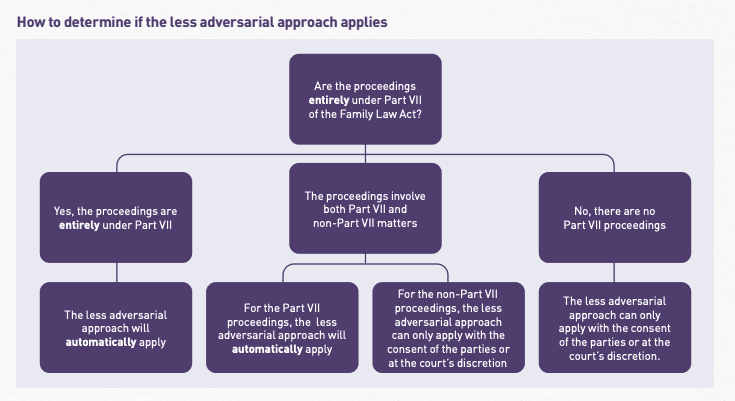
The Amendment Act outlines the Court’s authority to proceed with a less adversarial approach, aiming to reduce intimidation and stress of court processes for families. This less adversarial approach can include:
using technology to facilitate remote attendance where there are allegations of family violence,
allowing evidence of the occurrence and effect of family violence which may not otherwise be admissible,
suspending portions of the rules of evidence (unless the Court orders they should apply to an issue in proceedings in exceptional circumstances).
The table above (taken from the Attorney-General’s Department PDF on Family law changes from June 2025) outlines how you can determine whether the less adversarial approach can be either automatically applied to your proceedings, or can only be applied with consent of the parties or at the discretion of the Court.If you have any questions on the table above, don’t hesitate to contact our legal team at Oxford Partners Lawyers for more information.
Duty of disclosure (in property and financial matters)
Under the Amendment Act, the duty of disclosure now applies from the moment negotiations for property and financial settlements begin and all the way through until a resolution has been reached. Non-compliance to the duty of disclosure will now be met with stronger penalties (including potential criminal penalties such as fraud charges), and the overturning of agreements made when assets were hidden.Details that must be disclosed include:
All assets and liabilities
Superannuation
Any interests held in trusts and/or companies
Arbitration
The Amendment Act includes a single, collated list of matters that are eligible for arbitration. This helps remove unnecessary distinctions between the types of Family Law matters that can be arbitrated privately or by Court order.Under the Amendment Act, an arbitrator can now also apply to the Court for orders about the conduct of the arbitration. This includes requesting the termination of an arbitration in cases where a change of circumstance has made the arbitration no longer appropriate or potentially even unsafe for any parties involved.
Schedule 2: Children’s contact services
The Amendment Act enables the Australian Government to establish accreditation requirements for children’s contact services (CCS). These requirements are to be formally established as industry regulations.Once these new regulations are enacted, Courts will only be able to refer Australian families to accredited CCS providers. Penalties can apply for non-compliance from CCS providers.The Amendment Act now also limits the sharing of information that could potentially compromise the safety of children and families in accessing CCS. The example provided here by the Attorney-General’s department is details of a public transport route and schedule that a family member might use to attend a session.
Schedule 3: Case management and procedure
Removing limitation on applications for divorce
Prior to the rollout of the Amendment Act, couples who had been married for less than two years first had to attend counselling and obtain a certificate outlining that they had accessed professional support to consider the possibility of reconciliation. The Amendment Act has now removed this requirement, ensuring that couples who have been married for less than two years will now be subjected to the same processes under Part VI of the Family Law Act. Note: couples must still be separated for a minimum of 12 months and one day to be eligible to apply for a divorce order.
Attending family dispute resolution before applying for Part VII orders
To be eligible for a successful application of a parenting order, parties must now be required to file a certificate from an accredited family dispute resolution practitioner to confirm that parties have attended family dispute resolution, and that the practitioner in question does not consider FDR to be the appropriate path of action for the unique circumstances of those parties.
Exemptions of this FDR certificate are as follows:
There is documented urgent need for the parenting order
There has been child abuse and/or family violence by a party
There is a risk of child abuse/family violence by a party if a delayed approach is taken
A party is unable to participate in FDR (i.e. due to geographic location or other incapacity)
There’s historic evidence that a party who has allegedly contravened an order made in the last 12 months behaved in a way that shows a serious disregard for their duties/obligations under that order.
If none of the above exemptions are demonstrated, the Amendment Act now allows the Court to reject a Part VII (parenting) application for filing if no FDR certificate is presented, however parties can seek a review of this rejection in some instances if required.
Attendance at divorce proceedings
Changes to Section 98A of the Family Law Act now allows the Court to hear sole divorce applications without attendance at Court (even if there are children under the age of 18 years to the marriage). Under the Amendment, divorcing parties will also have the same court attendance requirements, regardless of whether they file solely or jointly, or whether there are children of the marriage.
Commonwealth information orders
In cases where a parent or guardian relocates with a child without consent from other parties involved in a parenting agreement, the Court can grant a Commonwealth information order (CIO) which compels Commonwealth departments or agencies to provide information concerning the location of that child to work towards the recovery of that child and/or the service of a parenting application.Under the Amendment Act, CIOs are no longer limited to the child, a parent, or a person with whom the child lives. Now, the category of persons that Commonwealth departments or agencies may need to provide information to under a CIO has been expanded to include parents, siblings, grandparents, uncles and aunts, nieces and nephews, cousins, step-relatives, foster relatives, and any other person the court deems relevant and whohas a connection to the child (for example, a person who lives with or cares for the child).
Jurisdiction of state courts to make parenting orders
The Amendment Act outlines the operation of existing provisions of the jurisdiction of state or territory courts to approve Family Law parenting orders. The amendment explicitly empowers a state or territory court prescribed for the purposes of Section 69GA with the same jurisdiction under Part VII of the Family Law Act as if those proceedings were heard in a state or territory court of summary jurisdiction.
Protecting sensitive information
The Amendment Act includes provisions for preventing access to evidence relating to confidential communications (i.e. ‘protected confidences’) on the basis that disclosure of this evidence may be distressing and harmful to parties involved.Some examples of evidence that falls under the umbrella of protected confidences includes:
Where a person seeks treatment or support from health services, or family/sexual violence services
Any other services where there is an express or implied obligation of confidentiality from practitioners
When a party requests or subpoenas records which include protected confidences, the Court has the authority to make a direction to protect this type of evidence where access would be likely to cause harm to a protected confider or a child involved in the proceedings. Here, the Court will decide whether the harm (i.e. physical/psychological/financial harm, etc.) to affected parties or children were the evidence to be disclosed, would outweigh the desirability of accessing that evidence. In parenting proceedings, the best interests of the child will be the Court’s foremost consideration.
Schedule 4: General provisions
Costs orders
The Amendment Act now replaces the costs provisions in the Family Law Act to provide greater clarity about when and how the Court can make costs orders in Family Law matters. The amendments to cost orders includes:
Provisions that were found in the Federal Circuit and Family Court of Australia (Family Law) Rules 2021 and Family Court Rules 2021 (WA) into the Family Law Act, including rules relating to when a party may make an application for costs, how costs will be calculated, and the types of costs orders that the Court may order
Clarifications that recipients of assistance under the Family Violence and Cross-examination of Parties Scheme may be ordered to pay for costs of the ICL unless an existing financial hardship provision applies
Clarifications that cost orders can be made against parties who previously received legal aid, but are no longer eligible due to a change in financial circumstances.
Rule-making power for a Family Court of a State
The Amendment Act provides a new power for a Family Court of a State to make its own rules of court when exercising its federal Family Law jurisdiction. These changes support the Family Court in Victoria to make and change Court rules without requiring approval from the judges of the Federal Circuit and Family Court of Australia (Division 1).
Review of approved methods and factors for valuing superannuation interests
The Amendment Act establishes a power to make regulations requiring superannuation trustees to review the actuarial formulas (called the approved methods and factors) used to value superannuation interests for Family Law matters. This includes transitional arrangements to be made for the Family Law (Superannuation) Regulations 2001, by providing the Minister with the power to approve ‘transition factors’ for calculating a non-member spouse’s entitlement after a family law superannuation splitting order or agreement.
Separation declaration requirements
The Amendment Act removes certain separation declaration requirements for parties seeking to split their superannuation by agreement, where the total value of a member’s superannuation interests exceeds the low rate cap set under the Income Tax Assessment Act 1997. This reflects that the low rate cap is no longer relevant for taxation purposes from 1 July 2024.
Have more Family Law questions? Speak with our team today.
All of the June 2025 amendments to the Family Law Act as outlined in the Amendment Act 2024 will be scheduled for review after the 10th of June 2028 to assess the efficacy of implementation and adherence to these amendments. Our legal team at Oxford Partners Lawyers anticipate the Parliamentary report outlining this review and plan to keep our clients updated accordingly.To keep in the loop with this and more legal news, visit our blog. Or check out our legal resources page to explore the information provided above directly from the source at the Federal Circuit and Family Court of Australia websites and other relevant sources.
Book a Free 30 Minute Consultation
Simply complete the form below. We will respond as soon as possible



 (03) 9670 7577